

Old Mine Cut vs Old European Cut: What’s the Difference?
Old Mine and Old European Cut diamonds are sometimes mistaken for one another – particularly by someone encountering antique diamonds for the first time.
Look more closely, however, and they tell two different chapters in the development of diamond cutting.
Both pre-date the modern Round Brilliant and both were traditionally cut by hand. The differences lie in their shape, proportions and the way they interact with light.


The Shape
One of the easiest clues is the overall outline.
An Old Mine Cut will commonly have a squarer, cushion-shaped appearance with softly rounded corners. Because the cutter was working with the natural rough stone, the outline may also be slightly irregular.
An Old European Cut is generally much rounder. It represents the progression towards the circular outline eventually associated with the modern Round Brilliant.
Those distinctions are not absolute, however. Antique diamonds were individually cut, so there can be considerable variation from one stone to another.

The Facets and Sparkle
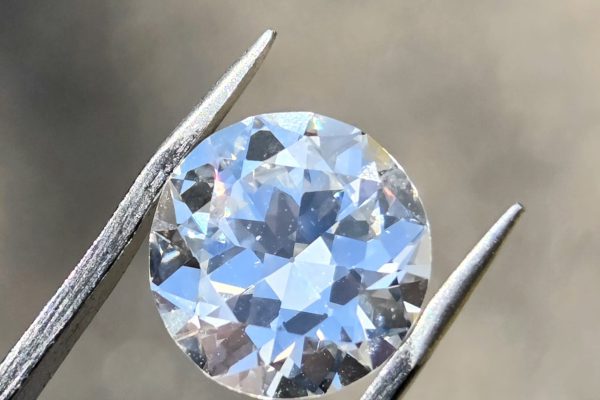
Old Mine Cuts are renowned for their large facets and bold flashes of light. Their sparkle can appear broader, warmer and less uniform than that of a modern diamond.
Old European Cuts became more symmetrical while retaining relatively broad facets. They can produce wonderful fire, particularly in changing light.
Modern Round Brilliant diamonds use more standardised proportions and precisely aligned facets to create a faster and more consistent pattern of brilliance.
Put them beside one another and the distinction can be striking. The antique stones aren’t simply less precise versions of a modern diamond – they have a different visual character altogether.
The Culet
Another useful clue is the culet: the point at the very bottom of a diamond.
Many Old Mine and Old European Cut diamonds have an open culet, which can appear as a small circle or facet when looking directly through the top of the stone.
Modern brilliant diamonds generally come to a much finer point, meaning the culet is usually extremely small or effectively invisible to the naked eye.
A visible culet alone doesn’t prove that a diamond is antique, but it can be an important clue when considered alongside its other characteristics.
Hand Cut vs Precision Cut
Perhaps the most important distinction is how the diamonds were made.
Historic Old Mine and Old European stones were cut in an era when much of the process relied upon the eye, judgement and skill of an individual cutter.
This is why genuine antique stones can show small asymmetries in their facet pattern, outline or proportions.
Modern cutting seeks far greater consistency. Computer modelling, precision equipment and an advanced understanding of diamond optics allow cutters to reproduce highly controlled proportions.
The difference is visible in the finished stone: one bears the individual character of hand craftsmanship; the other reflects modern precision.


Which Cut Should You Choose?
This comes down to the character you are drawn to.
Someone looking for perfect symmetry and intense, consistent brilliance may naturally gravitate towards a modern Brilliant Cut.
For collectors of antique jewellery, however, the irregularity and individuality of an older stone can be precisely what makes it special.
An antique diamond has already existed through generations. Its proportions and facets are part of that history rather than something that needs to be corrected.