
A Guide to Antique Diamond Cuts

No two antique diamonds are quite alike. Cut by hand in an age before computer modelling and modern precision machinery, antique diamonds have a character that is difficult to reproduce: individual proportions, broad facets and a distinctive relationship with light.
Diamond cutting has changed enormously over the last three centuries. From the softly glowing Rose Cuts of early jewellery to the increasingly symmetrical Old Mine and Old European Cuts, and eventually today’s precision-cut Round Brilliant, every period developed its own approach to revealing the beauty of a diamond.
Understanding these cuts is part of understanding the jewellery itself. The shape, facets and proportions of a stone can offer clues to its age, while giving each antique piece its unmistakable personality.
Antique Diamond Cuts: A Story Told in Light
No two antique diamonds are quite alike. Cut by hand in an age before computer modelling and modern precision machinery, antique diamonds have a character that is difficult to reproduce: individual proportions, broad facets and a distinctive relationship with light.
Diamond cutting has changed enormously over the last three centuries. From the softly glowing Rose Cuts of early jewellery to the increasingly symmetrical Old Mine and Old European Cuts, and eventually today’s precision-cut Round Brilliant, every period developed its own approach to revealing the beauty of a diamond.
Understanding these cuts is part of understanding the jewellery itself. The shape, facets and proportions of a stone can offer clues to its age, while giving each antique piece its unmistakable personality.


Rose Cut Diamonds
Rose Cuts belong to one of the oldest important traditions of faceted diamond cutting and can be found in jewellery dating back several centuries.
Unlike later Brilliant Cuts, a traditional Rose Cut has a flat base with a domed upper surface formed from triangular facets. Its relatively shallow construction and broad facets produce a very different visual effect from a modern diamond.
Rather than rapid flashes of brilliance, Rose Cut diamonds tend to shimmer and glow as they move. This softer interaction with light was particularly suited to the candlelit environments in which many early examples would originally have been worn.
Their appeal today lies precisely in that difference. A Rose Cut isn’t trying to behave like a modern Brilliant Cut; its beauty comes from its history, unusual faceting and gentle play of light.

Old Mine Cut Diamonds
By the late 18th and 19th centuries, Brilliant-style diamond cutting had developed considerably. The Old Mine Cut became one of the defining diamond styles of the Georgian and Victorian periods.
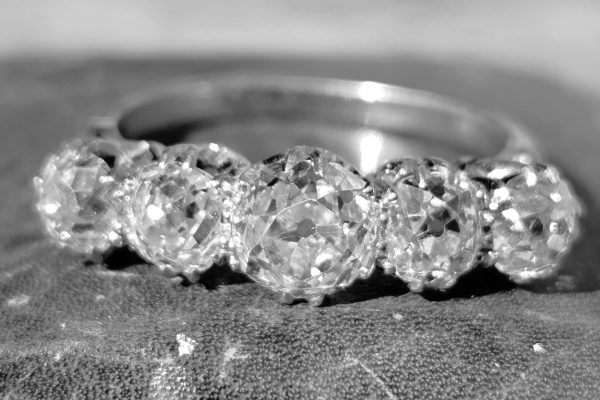
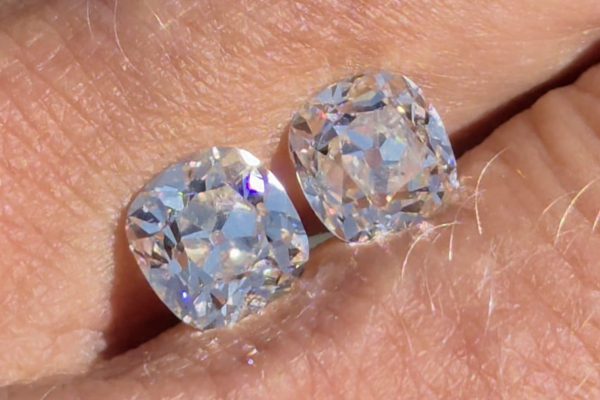
Old Mine Cut diamonds typically have a cushion-like outline, relatively deep proportions, broad facets and an open culet visible at the centre of the stone.
Because these diamonds were shaped individually by hand, cutters often worked with the natural form of the rough diamond rather than attempting to achieve a predetermined mathematical shape. As a result, subtle irregularities and differences between stones are not necessarily flaws – they are part of their character.
The larger facets can create bold flashes of light rather than the faster, more uniform sparkle associated with a contemporary brilliant.
For collectors of antique jewellery, that individuality is a significant part of their attraction.

Old European Cut Diamonds
As cutting techniques continued to develop during the late 19th and early 20th centuries, the Old European Cut emerged.
It represents an important step between the Old Mine Cut and the modern Round Brilliant.
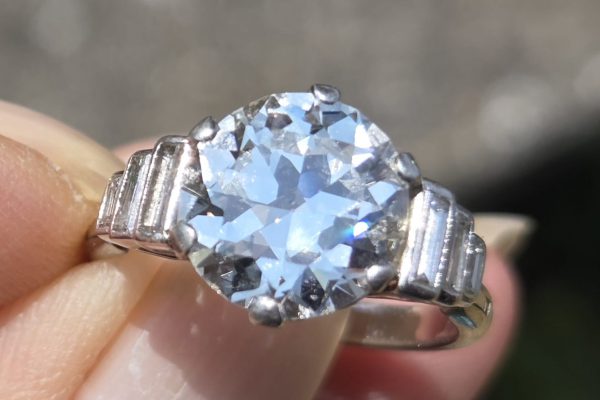
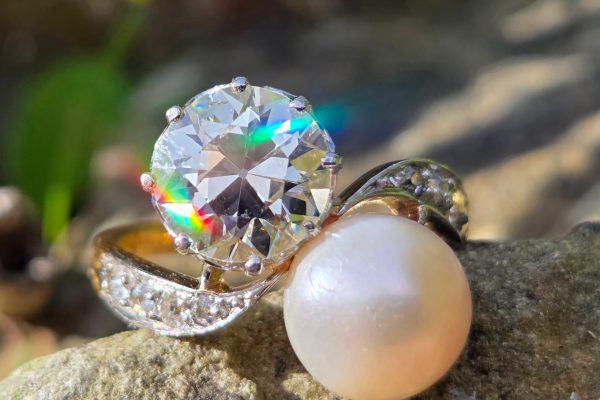
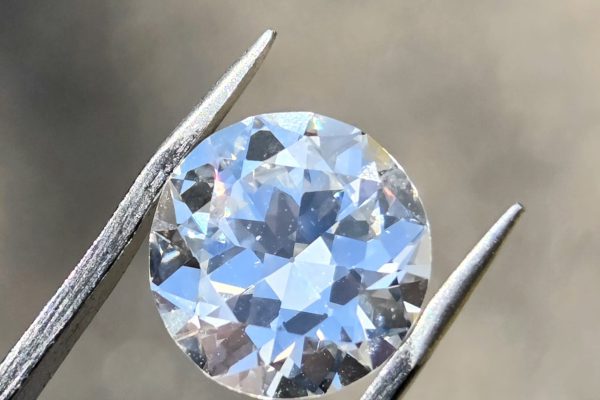
Old European Cuts generally have a rounder outline than Old Mine Cuts while retaining many characteristics associated with hand-cut antique diamonds: relatively high crowns, small tables, larger facets and visible culets.
They can possess wonderful fire and sparkle, but their appearance remains noticeably different from a modern precision-cut diamond.
Even when two Old European diamonds have similar dimensions, their hand-cut nature means each can have its own distinctive personality.

Transitional Cut Diamonds
The Transitional Cut tells another fascinating part of the story.
Appearing principally during the early decades of the 20th century, these diamonds bridge the gap between Old European Cuts and the increasingly standardised modern Round Brilliant.
Improved cutting equipment allowed greater symmetry and consistency, while cutters were beginning to understand more about proportions and light performance.
The result is a fascinating combination: some of the broad-faceted charm associated with antique diamonds alongside the increasing symmetry and brilliance that would eventually define modern diamond cutting.
From Hand Cutting to the Modern Brilliant
The development of diamond cutting is ultimately a story of changing priorities.
Earlier cutters worked largely by hand, responding to the individual rough diamond in front of them. Their aim was to reveal beauty while retaining valuable diamond weight using the techniques available at the time.
As technology and the understanding of optics developed, cutting became increasingly precise. Proportions became more standardised and modern Brilliant Cuts were engineered to maximise brightness, fire and scintillation.
Neither approach makes one diamond inherently more beautiful than another. They simply create different kinds of beauty.
For us, it is the individuality of antique diamonds – the evidence of the cutter’s hand and the way each stone interacts with light – that makes them so compelling.